
The Mystique of Michael Saylor
Deciphering the Saylorian rhetoric on Bitcoin.

This post is a translation of an article I wrote in French.
Michael Saylor, the executive chairman of MicroStrategy, has become extremely popular within the Bitcoin community over the years. As I explained in the first article of this two-part series, he managed to carve out a place for himself among bitcoiners, appearing on large-audience podcasts, speaking at major conferences, drawing the attention of specialized media—so much so that he has become, in a sense, a figurehead of the orange coin.
And yet, this general fascination with the man deeply surprised me. I found it mysterious that people who sincerely loved Bitcoin—that is, beyond mere financial gain—could take this man seriously. I obviously objected to his most peremptory pronouncements, expressed in certain short interview clips I had overheard. And yet, having never made the effort to listen to his long-form appearances, I persuaded myself that his perspective on money and Bitcoin must have unsuspected qualities. I assumed it was somewhat similar to Saifedean Ammous’s views, which, despite their flaws, had the merit of not outright rejecting the value proposition of electronic cash.
It was to fill this gap in my knowledge of the Saylorian rhetoric that I recently read The Treasury of Michael Saylor.1 It is an anthology published in 2025 that compiles Saylor’s most striking statements made in podcasts and conferences. The content was selected and reorganized by investor and educator Anil Patel, already the author of The Bitcoin Handbook in 2023.
My first impression, while going through this book, was a feeling of emptiness. Admittedly, the text came from spoken appearances, and one should therefore expect the substance of the message to be scattered along the flow of speech. But it seemed to me that Saylor’s deep thoughts on Bitcoin (supposedly highlighted in this compilation) were barely coherent, sometimes meaningless, even completely improvised… When he stays within his area of expertise, namely finance and business management, Saylor shows relevance and can teach us things. His rhetoric on the cryptocurrency, on the other hand, is akin to technobabble: he uses a pseudo-technical language to sell his products, while in reality having only a meager understanding of how the Bitcoin protocol works.2
Despite what he wants to project, Saylor is not an engineer or an ideologue; he is a magician. He uses artistic vagueness to create a kind of aura around himself, the source of his charisma. Like a Kabbalistic numerologist, he plays with numbers to astound his audience.3 Like an alchemist, he transmutes people’s credulity into assets on his company’s balance sheet.
Saylorism is therefore not really a solidly defined dogma, but rather a mystique, that is a “an air or attitude of mystery and reverence developing around something or someone”. And it must be said that this Saylorian mystique fascinates crowds. That is why it seems essential to decipher it here, not to prove that the man is stupid and talks nonsense, but to show that the spirit of his words is undeniably antithetical to what Bitcoin stands for.
A Promethean Vision of Life
The Saylorian mystique seems complicated by its convolutions, but it becomes clear once you understand the rational underlying it. In particular, it draws on a very old philosophical current that is enjoying growing success today. That current is Prometheism, for which technology is a liberating force that enables individuals to emancipate themselves from their condition. It takes its name from the Titan of Greek mythology, Prometheus, who allegedly stole the sacred fire from the gods of Olympus to give it to mankind, thereby teaching them all the arts and techniques, and who was condemned by Zeus to perpetual torture as a consequence of this act.4
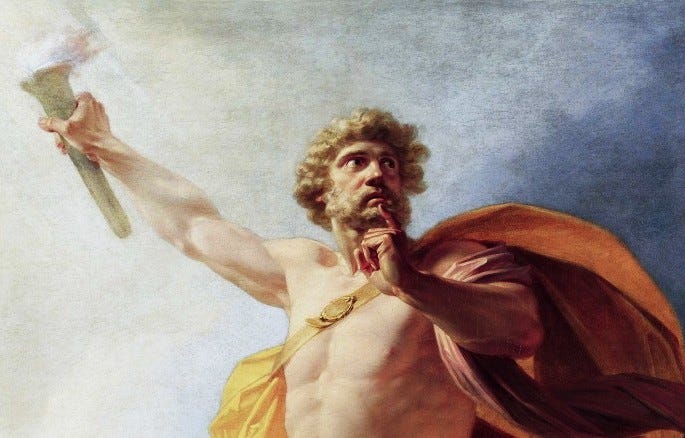

Michael Saylor fully subscribes to this conception of life, viewing the technological growth favorably. And this perspective manifests itself in his view of Bitcoin. For example, he considers that the progress of civilization throughout history has stemmed from its capacity to channel energy—from the taming of fire to the mastery of nuclear fission, through the exploitation of oil—and sees the cryptocurrency as an enhancement of that capacity.
Saylor thus goes so far as to directly compare Satoshi Nakamoto, Bitcoin’s creator, to the Titan Prometheus. In his view, Satoshi “offered us a gift” by developing his system, and should therefore be regarded as a demigod. He says it openly:
“Satoshi is the bringer of fire, Prometheus. He brought us sound money and I think that’s awesome. … Satoshi is a spiritual figure in the Bitcoin Community. I mean, Satoshi is equivalent to Prometheus. Prometheus gave us fire; Satoshi gave us money. Bitcoin is the first perfect money, the first perfect money in the history of the human race.”
Beyond this reverence for Prometheus, Saylor draws on ideas that are very clearly Promethean in nature. The Saylorian mystique thus falls within Objectivism, the philosophy of libertarian novelist Ayn Rand, which exalts heroism, rational selfishness, and capitalist entrepreneurship. Prometheism clearly shows through in the author’s works, where direct references to the Titan can be found.5
Saylor was particularly influenced by Atlas Shrugged, the novel published in 1957 in the United States. This book depicts engineers who secede from the sclerotic socialist collective whose burden they bear, gathering in “Galt’s Gulch,” a valley located in the middle of the Rocky Mountains and concealed by a technological light-refracting device. In his keynote speech at the Atlas Society’s Annual Gala in 2022 (Note: The Atlas Society is a nonprofit organization that promotes Ayn Rand’s philosophy in the United States.), Saylor paid tribute to the work:
“Ayn Rand’s stories are stories about the struggle of the individual against the collective and they’re gripping. When I first read Atlas Shrugged, I couldn’t put the book down. It became a 12 and then a 14, and then a 16 hour-a-day exercise. Human nature doesn’t change. That struggle existed a hundred thousand years ago. That struggle exists today. What does change is technology.”

Finally, Michael Saylor was also heavily influenced by science-fiction author Robert Heinlein, known for writing Starship Troopers, whose worldview is close to Prometheism.6 MicroStrategy’s chairman has read all of his novels, including The Moon Is a Harsh Mistress (1966), which he has said is “one of his favorite books.” This latter book tells the story of the war of independence waged by the lunar colony of Luna against Earth, which is won with the help of a ballistic system run by an artificial intelligence (named Mike). Heinlein presents very libertarian ideas in it: notably the adage that “there ain’t no such thing as a free lunch”, meaning that most things presented as “free” are in fact paid for by someone else, such as public services. And again there is this idea that technological mastery allows one to regain freedom by seceding.
For Michael Saylor, Bitcoin thus corresponds exactly to the Promethean project, something Hellenophile bitcoiners noticed well before him, such as Andreas Antonopoulos (as early as 2013). But unlike Antonopoulos, Saylor has his own particular interpretation of how Bitcoin must free the world from Zeus’s tyranny…
Energy and Thermodynamics
In keeping with his Promethean philosophy and his brief engineering background, Michael Saylor sees the world through the lens of science and thermodynamics. The notion of energy, which is central to physics, recurs constantly in his rhetoric, including regarding cryptocurrency. Among other things, he considers bitcoin to be “digital energy,” much like steel, which is “a metallic form of energy,” and oil, which represents “a liquid form of energy.”
This claim is more a figure of speech than anything else, for bitcoin has no direct link to energy. Admittedly, the network is secured by a process involving electricity consumption in the real world; but the unit of account has never been backed in any way by the energy consumed to create it. Satoshi Nakamoto had in fact already refuted this idea in his day, explaining that bitcoin was not “stable-with-respect-to-energy.”
Of course, one could argue that this metaphor helps explain the good monetary properties that commodities typically possess as standardized products (and that bitcoin exhibits). Except that it takes a preponderant place in his rhetoric, and it justifies all sorts of absurdities. For instance, Saylor considers that there can be no money without energy expenditure and that (echoing banker J. P. Morgan’s famous quip about gold) everything else is credit. For him:
“Money without energy is credit. Commodities without energy are coupons. In cyberspace, an object without energy is an image. If you have an object and there’s no energy, it’s like Plato shadow, a person without energy is a ghost.”
Within this framework, only bitcoin can constitute real digital money, since central bank money requires no work to be produced.7 Invoking energy serves to legitimize Bitcoin as the future foundation of the economic system.8
Michael Saylor also leans heavily on thermodynamics, and on the three laws that compose it: the conservation of energy, the inescapable growth of entropy, and the emergence of self-dissipative structures. In his rhetoric, he likens Bitcoin to a stable physical system, impervious to external disturbances. This allegory leads him to present the rise in bitcoin’s price as a quasi-scientific necessity. He explains that betting on bitcoin amounts to placing your money on the second law of thermodynamics, and therefore that it is a safe bet:
“When you take your money and you put it in a bank and and you save it in a fiat currency, you’re loaning your money to a country. When you when you take your money and you buy a stock, you’re loaning your money to the management team of a company. When you take your money and you buy a building, you’re loaning your money to the mayor of a city. When you take your money and you buy a piece of art, you’re loaning your money and investing your money in a culture. When you actually buy Bitcoin, you’re loaning your money to the lords of entropy, you’re loaning your money to the gods of chaos. What’s the bet? The bet is that chaos will outperform cities companies countries cultures.”
A Certain View of Inflation
Michael Saylor’s entire approach to Bitcoin is, as we saw in the first article of this two-part series, to manage to preserve his wealth despite external events. And one of the things that drew him to the cryptocurrency is the threat of the generalized rise in prices, or the decline in the value of currency, a.k.a. inflation. However, he has a particular conception of this phenomenon.
First, he defines inflation as a “vector” rather than a “scalar,” a mathematical way of saying that it is a multi-dimensional variation. As he explains:
“And of course, what you see is that as you start to print more money, inflation is not distributed equally. There’s not really a single inflation number. There’s a vector of inflation.”
It is indeed incorrect to reduce inflation to a single parameter, as the official world does with the Consumer Price Index (CPI), which takes into account the average price of a basket of goods. The price of apples varies differently from that of computer components or that of housing in a big city. In this way, real inflation is largely underestimated, which is a boon for those close to the issuance of new money.
Where Saylor’s analysis goes astray is when he conflates the swelling of prices with money creation. In his view indeed, “the currency is losing 7% of its value a year,” a figure that corresponds to the annualized rate of money issuance in Western countries and to the average increase of the S&P 500. Consequently, for him, “If you’re getting paid less than 7% on your investments, you’re getting poorer.”
Saylor thus disregards economic growth, which partly offsets the loss of purchasing power that would occur if total wealth remained the same. Admittedly, central bankers benefit greatly from their status as issuers, but that does not mean that the issuance of new money always feeds through to prices. In the hypothetical case where both twice as much money and twice as many goods and services were created in an economy, prices would remain roughly the same.
This error nevertheless reveals something important about Michael Saylor: his competitor’s mindset. One senses that he believes, in a way, that to stagnate is to regress. His philosophy corresponds to an economic transposition of the Red Queen hypothesis, a biological hypothesis that postulates that a species must constantly evolve to maintain its fitness in the face of the evolution of the species with which it coevolves.9 Saylor lives in a frenetic world where one must constantly keep moving forward to avoid being left behind by others. He wants to preserve not only his wealth, but also his rank in society.
Bitcoin as Digital Capital
Capital is a good employed in the production of another good. When it comes to a sum of money, the investment of that sum must generate interest. Capital is thus a way of creating value. And it is therefore a major asset for maintaining one’s economic position.
Michael Saylor has a multifaceted conception of Bitcoin. In his eyes, it is not a currency that serves as a means of payment in everyday life; he reserves that function for the dollar and its derivatives. It is, on the other hand, at once a kind of commodity, a type of property, a form of energy and, above all, a sort of capital. He believes that bitcoin constitutes a digital capital destined to generate an income resembling interest, derived from its price appreciation, which he estimates at 29% per year, forever.

According to him, buying bitcoin is a positive-sum game, unlike gambling: “Bitcoin’s the only game in the casino that we can all win.” In this way, a declinein price is a setback, and even an opportunity. In his mind, volatility is indeed a sign of vitality; more than that, it is “a gift to the faithful.”
This almost mechanical conviction in the perpetual annuity derived from bitcoin logically leads him to advocate not only buying it, but also borrowing money to buy it. He says it plainly:
“What you want to do is borrow money for 10 years or longer, and you’d like to get the interest rate below 10%. … If you were smart enough to take a 30-year or 20-year mortgage at 3 or 4% and buy Bitcoin, you are financial genius. Not complicated: you’re swapping 3 or 4% cost of capital for a 29% return on the capital.”
Saylor considers that Bitcoin’s invention opened a breach in the traditional financial system. Through leverage, anyone can thus enjoy the advantages of the old world based on fiat money and credit, while having a foot in the new world based on “digital capital.” This is the investment thesis behind MicroStrategy’s business (rebranded as Strategy₿ since then), which has gone heavily into debt to build itself a bitcoin treasury worth $55 billion today.
However, this conception of bitcoin as capital is an economic sophism. No matter how many times Saylor repeats it, bitcoin is nothing like capital: it is base money. Its initial monetization admittedly caused a steady rise in price (following the rhythm of the various halvings), but bitcoin’s purchasing power has no reason to increase as it has in the past. Eventually, it will stabilize, and only “natural deflation” will persist. As Satoshi Nakamoto explained in his day:
“Bitcoins have no dividend or potential future dividend, therefore not like a stock. More like a collectible or commodity.”
Michael Saylor is a foolish man who built his house on sand, whose foundations will collapse when the storm comes. As during the dot-com bubble, he is betting everything on the enthusiasm generated by his charisma; once the spell wears off, the fall will be vertiginous.
Self-Custody and Privacy
Another element of the Saylorian mystique is the ambiguous position he maintains toward self-custody and privacy. Saylor claims to respect these values, but in practice never sides with them: neither in words nor in deeds.
On the one hand, he is naturally a proponent of intermediation by financial institutions. His rhetoric is symptomatic of the reversal that has slowly taken place since the publicaiton of the white paper in 2008. In the very first sentence of this founding document, Satoshi Nakamoto summed up Bitcoin’s raison d’être as the possibility for online payments to be “sent directly from one party to another without going through a financial institution”. Today, top financial figures like Michael Saylor and Larry Fink advocate custody through an institution, relegating self-custody to the background.
One can assume that Saylor is acting in good faith, believing that Bitcoin can no longer be attacked head-on. Thus, when New Zealand podcaster Madison Malone speaks to him about the possibility of bitcoin confiscation by the authorities (as Executive Order 6102 did for gold in the United States in 1933), he dismisses this argument as “a myth and a trope that goes on over and over again,” one propagated by “paranoid crypto anarchists.” Moreover, he shifts the blame onto them, judging that they increase the risk of seizure by their very existence, because they “don’t acknowledge government, or don’t acknowledge taxes, or don’t acknowledge reporting requirements.” He elaborates:
“So normally, the risk is greater when there [are] unregulated private entities that are perceived to be holding the asset. When you have regulated public entities like BlackRock and Fidelity and JP Morgan and State Street Bank holding the asset, … there’s no way that all the senators and all the congressmen are going to seize the assets from Fidelity and BlackRock or Vanguard because that’s where all their retirement money is invested.”
On the other hand, Michael Saylor is completely opposed to privacy on Bitcoin’s chain, which is nevertheless an essential element of the cryptocurrency,10 reserving it for networks built as second layers. He explains:
“If Bitcoin diverted all of their energy to make itself private and became known as a network of complete and utter privacy, it probably is counter productive to its own interest. Because, you don’t want the united states government to say bitcoin is completely private, because now it becomes the perfect tool for a money laundering, now it becomes the enemy, now they’re going to shut it down. … There’s no way you’re going to get a hundred trillion dollars to flow into bitcoin if its use case is directly against the the interest of a government that is within. So you don’t want to be that good.”
Saylor confirmed this position in 2024 by remaining silent regarding the arrest of Samourai Wallet’s founders by the U.S. federal government. They offered a coin-mixing solution called Whirlpool, which allowed users to increase the privacy of their bitcoins. It served privacy-minded individuals, but also (obviously) outright criminals. Samourai Wallet’s founders—through their informal disobedience, then through their arrest and conviction—were, in a sense, martyrs for financial freedom: they bore witness that it was possible to use Bitcoin sovereignly.
But Saylor will have none of that. He wants to come out ahead, in the most materialistic sense of the term, which implies above all not sacrificing himself. In his keynote speech at the Atlas Society’s annual gala, he clearly states that he does not want to be a martyr, but a winner. Thus, he will probably never make any effort to promote this yet essential aspect of Bitcoin.
The Swarm of Hornets
As we have seen, Michael Saylor is very fond of metaphors, and the Saylorian mystique is therefore teeming with images of all kinds. One of the most striking of these images is that of the swarm of cyber hornets, which he long promoted on Twitter and has mentioned on several occasions. It came to him on September 18, 2020, following an “epiphany” about Bitcoin. He then rushed to the social network to write the following sentence:
“Bitcoin is a swarm of cyber hornets serving the goddess of wisdom, feeding on the fire of truth, exponentially growing ever smarter, faster, and stronger behind a wall of encrypted energy.”11
One might think he was thereby paying a sort of poetic tribute to Bitcoin and its community but, as he later explained, he was dead serious. Indeed, he does not see this image as “a cute metaphor”; for him, “it’s literally a swarm of cyber hornets that keep getting more powerful that you can’t kill that are going to get smarter and stronger and faster. And they’re going to eat you if you try to stop them.” It is the network’s immune system, which guarantees its antifragility:
“The antifragility of Bitcoin comes from the fact that everybody in the ecosystem feels the the same pain, in the same way. If Bitcoin’s price goes down, every Bitcoin holder feels it. If Bitcoin is hacked and goes to zero, every Bitcoiner loses their life’s energy. We are a hive creature all integrated with one another. And when there is that pain, it spreads very quickly through the entire ecosystem. The information flows rapidly.”
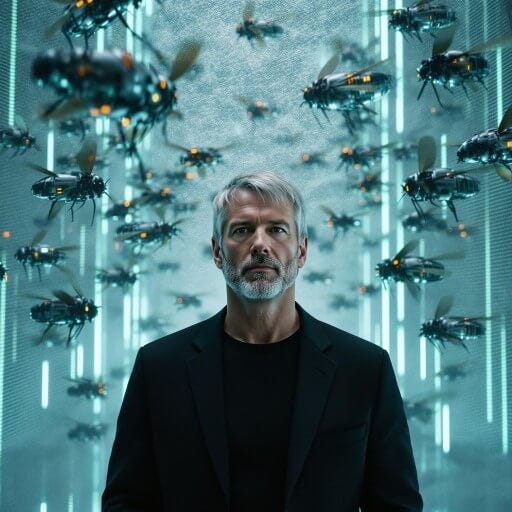
However, this metaphor is somewhat disturbing. The image of the swarm, which symbolizes the inescapable nature of a decentralized force, is not exactly reassuring, and even sounds like a threat to uninitiated ears. Saylor knows it: he is aware of the terror this image inspires, which is moreover very ancient.12 In a later podcast, he thus asserts (in a discussion about military technology) that “the most terrifying thing is not one creature attacking you,” or even “an army,” but “a swarm of bionic hornets.”
Moreover—and this is an puzzling detail—the hornet swarm metaphor had already been used in relation to Bitcoin in the past, by none other than Satoshi Nakamoto himself! In December 2010, he lamented the attention WikiLeaks had drawn to Bitcoin, considering that “Bitcoin is a small beta community in its infancy.” In his penultimate public message on the forum, he wrote:
“It would have been nice to get this attention in any other context. WikiLeaks has kicked the hornet’s nest, and the swarm is headed towards us.”
By the “swarm,” he was refering to the entire institutional apparatus, made up of political leaders, parliamentary representatives, judges, police chiefs, mainstream media journalists, etc. Thus, he viewed it negatively. If Saylor venerates the hornets, Satoshi deeply feared them. And the fact that the former unwittingly answered the latter a decade later speaks volumes about Bitcoin’s evolution over that period.
“Bitcoin Is for Everyone”
The involvement in Bitcoin of Silicon Valley and Wall Street financiers starting in 2013 caused some unease within the community: for a number of longtime members, this intrusion did not bode well, and would strip the cryptocurrency of its rebellious character. Hence the visceral reactions that followed. In June 2018, for example, Cøbra (the administrator of the Bitcoin.org website) called on Twitter to “push away these Silicon Valley statist venture capitalist pigs well away from Bitcoin, lest they turn it into another tool of the globalist elite.” However, a growing share of bitcoiners saw in this opening a natural and inevitable evolution of the sector, necessary for Bitcoin adoption to spread to the general public. Influencer Vortex replied to Cøbra as follows:
“It’s people like you who also create propaganda that incites wars. Bitcoin is a peaceful movement that will make fiat irrelevant, no need to hate on all VCs, there are plenty of good VCs out there. Bitcoin is for everyone and anyone who wants to use it, not just anarchists.”
This idea quickly turned into a catchphrase—“Bitcoin is for everyone”—which served to legitimize the inclusion of financiers. Many opinion-makers have invoked it, including among others StopAndDecrypt (alias Beautyon), Parker Lewis, Cory Klippsten and MrHodl.13 Moreover, a similar expression—“Bitcoin is for enemies.”—was coined by Pierre Rochard in 2018 to signify that the system is open to everyone, including ideological and geopolitical adversaries:
The idea was then taken up by Michael Saylor himself, who made the maxim “Bitcoin is for everyone” his own by using it as the title of his presentation at Bitcoin Atlantis in March 2024. He concluded his talk with the following words (which earned him a standing ovation from the audience):
“The digital transformation of capital and energy and property means that every person, every family, every corporation, every government, every movement can live their best life, achieve their greatest aspirations. … Bitcoin’s for everyone.”

The openness argument is defensible: it is true that we sometimes frown upon people we dislike getting involved in the same network as us, and this tends to create tensions (as evidenced by the current conflict over data inscription). By reminding everyone that Bitcoin is for everyone, we indicate that the system does not discriminate, despite existing animosities. We take distance from our own feelings.
And yet, this argument is a trap. Bitcoin is what people make of it: the consensus rules emanate from the set of all merchants who accept it. By welcoming more and more institutions that spread the message that bitcoin is a digital financial security and that push newcomers to go through them rather than hold their own private keys, we weaken Bitcoin. The slogan “Bitcoin is for everyone” has been instrumentalized to make the pill easier to swallow.
Just because anyone can participate does not mean we should welcome everyone with open arms. When a wolf enters the sheepfold, shouldn’t the sheep be wary?14
Now, in this context, Michael Saylor is indeed a wolf. He promotes a distorted vision of Bitcoin, regarding it as capital and not as a medium of exchange. He relegates self-custody to the background, not even deigning to implement it for his own company. He is flatly opposed to on-chain privacy, which is nevertheless essential to users’ security. He knowingly blocks all protocol changes, even though they are necessary for the development of programmability. He calls for strict financial regulation, based on know-your-customer requirements and due diligences checks. Everything he says and does therefore leads to the complete neutralization of Bitcoin.
Saylor bewitches bitcoiners by making them dream. He explains to them that Bitcoin will manage to contaminate the system from within like a Trojan horse, without institutional adoption affecting it in return. He predicts that the price will keep climbing ever higher, and that it will even reach $21 million in 2046. In his view, Bitcoin has already won; all that remains is to trust the banks to ensure its growth.
In this way of fascinating his audience, Michael Saylor is uncannily reminiscent of Craig Wright, the charismatic individual who passed himself off as Satoshi Nakamoto starting in 2015 and who managed to create a cult around his own version of Bitcoin (BSV). The Saylorian mystique falls into this category, except that it is far more subtle, and therefore much more effective.
A Good Lesson on Compromise and Compromission
Seeing the havoc Michael Saylor’s rhetoric wreaks on how newcomers perceive Bitcoin, one might be tempted to lay the blame on the man, who does not hesitate to use his charm to achieve his ends. One could also pin the responsibility on those who gave him credit, starting with podcasters and conference organizers. It would also be possible, following a less Manichean line of reasoning, to explain that the success of the Saylorian mystique among bitcoiners is the symptom of a disease that crept into the community long ago: love of money. But this denunciation would probably have little influence on the course of things. People hear what they want to hear, and only a brutal return to reality makes them understand the truth, as always.
The spread of Saylorism within Bitcoin is nevertheless a good illustration of the difference between compromise and compromission.15 Both are forms of renunciation, but they differ in spirit. Compromise is, above all, an outward act: it consists of adapting your demands to those of others, making concessions in order to reach a common agreement. Compromission, on the other hand, is an inner resignation: it involves altering your deepest convictions, going back on your moral principles, in order to relieve the cognitive dissonance that results from a mismatch between your actions and your values.
Bitcoin’s history is marked by compromise. Satoshi Nakamoto himself, for whom Bitcoin was a way to “gain a new territory of freedom” on the political plane, did not have a deeply hostile attitude toward authority. Even though he knew the importance of privacy, he refrained from presenting Bitcoin as “anonymous digital currency” so as not to put off the general public or anger the powers that be. It is in the same spirit that he handed the reins of the project to Gavin Andresen, the consummate compromiser, who in particular had a very measured attitude toward the dark web marketplace Silk Road.16
But this compromise gradually mutated into compromission, of which Saylor has become the most striking embodiment. The debate over the relevance of self-custody could never have taken place in Satoshi’s day, third-party custody being seen as a last resort, “for pocket change amounts.” Today, what was seen as a compromise is becoming the norm, with bitcoin-linked ETFs and MicroStrategy’s financial products.
So how do we fight compromission? Since compromise is inevitable, there is always a temptation to betray our principles to increase our mental comfort. The only way to oppose this inner resignation is therefore to remember, to remind ourselves why we are here in the first place. Admittedly, our position can evolve, but it need not be antithetical to everything Bitcoin promised.
“What is needed is an electronic payment system based on cryptographic proof instead of trust, allowing any two willing parties to transact directly with each other without the need for a trusted third party.” — Satoshi Nakamoto
This post was translated from French using Kimi K3 on Venice.ai and then revised by myself. The illustration was produced with GPT Image 1.5, based on a photograph of Michael Saylor taken by Jason Koerner in 2023.
Anil Patel, The Treasury of Michael Saylor: How Bitcoin Powers Cultures, Corporations, and Countries in the 21st Century, Yaletown Press, September 2025.
He has a particularly hazy view of the quantum threat to Bitcoin. In 2025, on The Jordan B. Peterson Podcast, he compared Bitcoin to other protocols such as the English language and the decimal system, and asserted that “if you have a computer program and it becomes insecure, you have to upgrade the program,” implying that it is the software that would need to be changed in the event of a quantum attack, not the protocol itself.
In Prague in 2025, for example, he predicted that the price per bitcoin would be “$21 million in 21 years.”
In Aeschylus’s play Prometheus Bound, the Titan lists the blessings he brought to mortals: carpentry, astrology, mathematics, writing, domestication, the two-wheeled chariot, seafaring, medicine, divination, metallurgy. He concludes this list by saying: “Hear the sum of the whole matter in the compass of one brief word—every art possessed by man comes from Prometheus.” (vv. 505–506) His punishment is described by the god Hephaestus who, commissioned by Zeus, carries out the sentence: “Lofty-minded son of Themis who counselleth aright, against my will, no less than thine, I must rivet thee with brazen bonds no hand can loose to this desolate crag, where nor voice nor form of mortal man shall meet thy ken; but, scorched by the sun’s bright beams, thou shalt lose the fair bloom of thy flesh. And glad shalt thou be when spangled-robed night shall veil his brightness and when the sun shall scatter again the rime of morn. Evermore the burthen of thy present ill shall wear thee out; for thy deliverer is not yet born.” (vv. 18–27) Translation by Herbert Weir Smyth.
In the novella Anthem (1938), set in a futuristic world where the concept of individuality has been eliminated in favor of the group and where people no longer have distinctive names, the hero (identified as “Equality 7-2521”) eventually takes the name “Prometheus.”
Methuselah’s Children (1941), which depicts characters who have acquired longevity through eugenics and are persecuted for it, is in a sense an apologia for transhumanism, for example.
In the interview cited, Saylor clearly states that “there is no digital money” other than bitcoin, and that the dollar and the euro are “credit and they’re not backed by energy.” Yet the digital money issued by central banks and held in reserve by commercial banks is indeed strictly digital base money, not based on a credit relationship. The policy-rate system attempts to reproduce the mechanism by imposing “interest rates” on newly produced money, but it is a device for regulating money creation, not any kind of claim.
This view is somewhat reminiscent of the argument developed by Pierre Noizat in his book Energy, the Flip Side of Money, published by Konsensus in 2025.
The Red Queen hypothesis takes its name from an episode in Lewis Carroll’s Through the Looking-Glass (1871), in which Alice and the Red Queen start running a race, and where Alice notices that the objects around them are not moving. The Red Queen then explains to her that the physics of Looking-Glass world is not the same: “Now, here, you see, it takes all the running you can do, to keep in the same place. If you want to get somewhere else, you must run at least twice as fast as that!” This last quote was very judiciously incorporated by Anil Patel into The Treasury of Michael Saylor.
Privacy, described in section 10 of the white paper, is inseparable from peaceful self-custody. Linking an address to its owner’s identity facilitates not only regulations enforcement and tax collection by government, but also theft by common criminals, as the wave of kidnappings in France in 2025–2026 amply demonstrated.
“I will send my fear before thee, and will destroy all the people to whom thou shalt come, and I will make all thine enemies turn their backs unto thee. And I will send hornets before thee, which shall drive out the Hivite, the Canaanite, and the Hittite, from before thee.” — Exodus 23:27–28. One can also think of the swarms of flies, gnats and locusts that are among the ten plagues of Egypt.
The slogan “Bitcoin is for everyone” was also used as the title of a book written by podcaster Natalie Brunell in 2025.
“Beware of false prophets, which come to you in sheep’s clothing, but inwardly they are ravening wolves. Ye shall know them by their fruits. Do men gather grapes of thorns, or figs of thistles?” — Matthew 7:15–16.
“Compromission” is the French word for “compromising behaviour.”
Without being in favor of Silk Road, Gavin Andresen defended the anonymous use of Bitcoin. In June 2011, following Senator Chuck Schumer’s intervention accusing the cryptocurrency of facilitating money laundering and drug trafficking, he wrote on his blog: “Second, nobody can control what is purchased with bitcoins, just like my local bank cannot control what I do with the cash I withdraw from their ATM machine.” This attitude differs on the one hand from the anarchist approach of an Amir Taaki, who fought tooth and nail for Bitcoin’s use by WikiLeaks and Silk Road, and on the other hand from the collaborationist posture of a Jeff Garzik, who explained that “attempting major illicit transactions with bitcoin … is pretty damned dumb.”