
The Success of Saylorism and the Corruption of Bitcoin
Where Michael Saylor's Growing Influence Comes From.

This post is a translation of an article I wrote in French.
Having been involved in the cryptocurrency space for a long time, in 2020 I witnessed the arrival of a singular figure in the spotlight—Michael Saylor, the CEO of MicroStrategy. I watched him frantically buy bitcoin through his company, accumulating nearly 850,000 coins over the course of six years, which are worth $55 billion today. I observed his influence grow within the Bitcoin community, among my peers and newcomers alike, as well as on American television and social media.
But this popularity hardly delighted me. Even though I was only half-listening, I quickly noticed that Michael Saylor’s rhetoric ran counter to Bitcoin’s fundamental values. Thus, his appeal to Bitcoiners was not so much a sign of Bitcoin succeeding in the high-level financial world, but rather the symptom of an advanced corruption. Hence the idea, in this two-part series, of revisiting the origins and arguments of the Saylorian dogma.
Michael Saylor and the Early Days of MicroStrategy
Michael J. Saylor was born in 1965 in Nebraska, in the heart of the American Great Plains. His father was a Air Force chief master sergeant, so his family had to move frequently during his childhood. In 1983, at the age of 18, he enrolled at MIT on a ROTC full scholarship, where he studied aeronautical/astronautical engineering and history of science. He wanted to become an airline pilot or an astronaut, but was prevented from doing so by a minor health issue.
After graduating, he worked as a consultant at a consulting firm, then at the industrial group DuPont. There he acquired expertise in computer simulation and economic forecasting. This is what led him to co-found MicroStrategy with an MIT fraternity brother in 1989, when he was only 24: a business intelligence company that specialized in developing software allowing client companies to use their data to gain insights into their operations.
MicroStrategy greatly benefited from the dot-com bubble that marked the turn of the millennium. The company went public in June 1998, and the price of its stock (MSTR) skyrocketed a year later, multiplying by more than 28 relative to the initial offering price. In March 2000, at its peak, the firm’s market capitalization reached nearly $12 billion, which made Michael Saylor a billionaire on paper. He was then hailed by the tech and business press as an outstanding entrepreneur1.
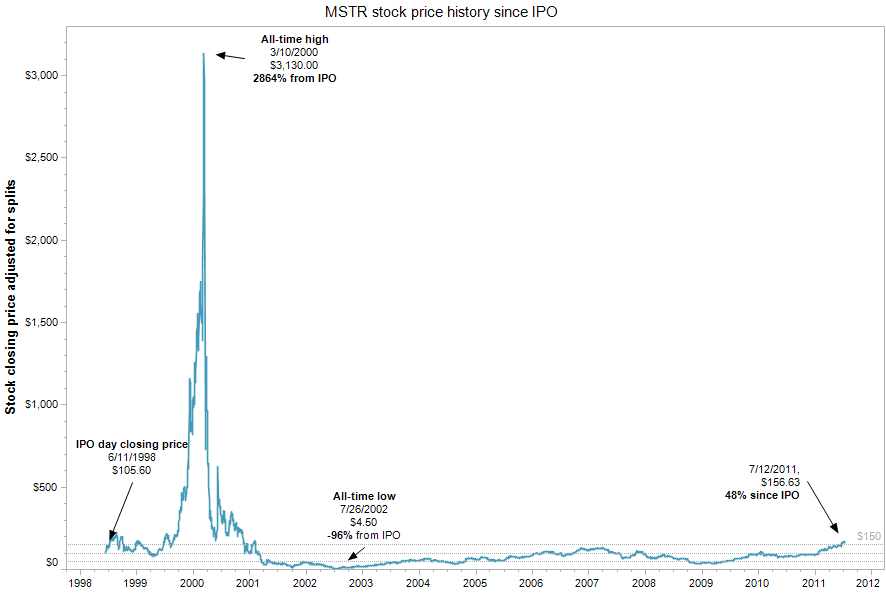
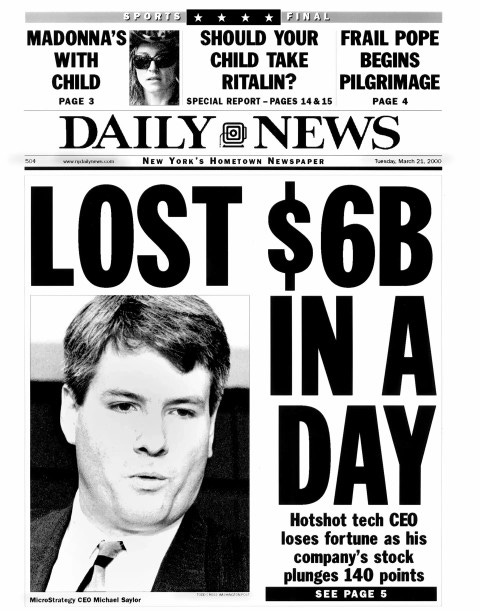
However, this golden reputation tarnished fairly quickly. On Monday, March 20, 2000, following a review of its accounting practices by PwC, MicroStrategy announced that it would restate its financial results for the preceding years2. This news triggered a brutal drop during the day, with the stock losing nearly 62% of its value in a single trading session. The next day, the story made headlines, being covered in the New York Times and the Washington Post. The media emphasized that Michael Saylor’s fortune had shrunk by $6 billion in a single morning!
On March 23, left-wing journalist David Plotz wrote a scathing profile of the CEO for Slate. Saylor was called “MicroStrategy’s cult leader.” He was described as a fusion of Bill Gates and Steve Jobs: being both “a ruthless, intimidating nerd” like Microsoft’s founder, and “a mesmerizing speaker” like Apple’s iconic leader. For Plotz, Saylor was a man obsessed with wanting to “change the world,” comparing himself to great American inventors and industrialists like Edison, Ford, Carnegie, and Rockefeller. He was a “star,” a “philosopher-king” and a “visionary.” The journalist added:
“His intensity and zeal are dazzling. He mesmerizes people. Saylor’s grand ideas are perfectly credible, but they’re nothing you haven’t read in Wired a dozen times. No matter: Saylor’s reality distortion field has alchemized MicroStrategy from a respectable data-mining company into some kind of Übercorporation.”
The bursting of the dot-com bubble forced Michael Saylor to endure a long dry spell. Stock market crashes followed one after another for two years. The stock price fell heavily, reaching a low in July 2002 corresponding to a twentyfold decline (-95%) from the IPO price. But the ship, with Saylor at the helm, made it through.
The Comeback and the Adoption of Bitcoin
In the early 2010s, Michael Saylor foresaw the advent of dematerialization and the cloud. In 2012, he wrote a book titled The Mobile Wave, in which he explained how the use of mobile devices (computers, phones, e-readers, game consoles, etc.) would influence commerce, healthcare, education, and developing countries. The success of the smartphone, the multifunction touchscreen phone ushered in by the release of the iPhone in 2007, was one of its most obvious manifestations. In his book, Saylor emphasized the importance of networks. He would share the following in a podcast in 2021:
“So, when I wrote The Mobile Wave, the observation was software networks are dematerializing everything in the world. They’re dematerializing money and identity and everything you hold in your hand, the photograph and the camera and the recorder and the video.”
He would later apply this analysis to Bitcoin, but at the time he was not yet convinced by Satoshi Nakamoto’s invention. He publicly criticized the cryptocurrency in 2013, predicting that it would suffer “the same fate as online gambling”—that is, a legal shutdown3.
In 2020, however, one event changed his mind on the matter: the COVID-19 pandemic. In March, as lockdown measures multiplied around the world and the economy collapsed as a result, Michael Saylor refused to close his company’s offices in the absence of a legal order and justified this choice in a lengthy memorandum emailed to his employees. In it (which had leaked on Reddit and in the press), he laid out his position regarding the coronavirus, writing in particular: “It is soul-stealing and debilliating [sic] to embrace the notion of social distancing & economic hibernation.”
Starting in April, central banks resorted to massive stimulus plans through money printing, foreshadowing the return of high inflation. Saylor then wondered how to preserve the value of his treasury’s cash holdings. Influenced by his friend Eric Weiss, he read The Bitcoin Standard by Saifedean Ammous, and began considering buying bitcoin. During a conference call held on July 28, 2020, he explained to MicroStrategy shareholders why the company needed “to maintain a healthy capital base” and had to invest its reserves in “alternative investments or assets which may include stocks, bonds, commodities such as gold, digital assets such as Bitcoin, or other asset types.” On August 11, this decision became official: the company announced it was adopting bitcoin as its “primary treasury reserve asset” and had purchased 21,454 of them for $250 million.
The Community’s Reception
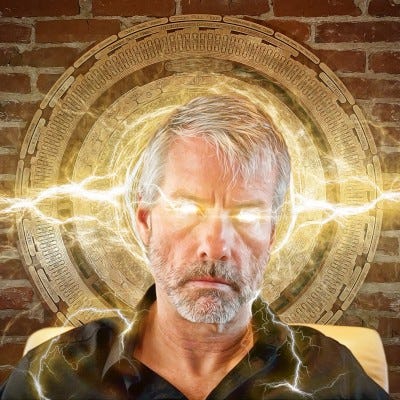
This news delighted a number of Bitcoiners, who saw it as the start of a mass adoption by publicly traded companies. Subsequently, Michael Saylor appeared on numerous podcasts dedicated to Bitcoin or cryptocurrencies: he spoke with Anthony Pompliano and Stephan Livera in September, participated in Peter McCormack’s What Bitcoin Did show in October, talked with John Vallis and Robert Breedlove in November, joined Preston Pysh in December, and appeared on Laura Shin’s Unchained in January 2021. He embraced Bitcoin culture by adopting its conventions, notably displaying the infamous laser eyes on his Twitter profile in April 2021. Over the course of the year, he was chosen by Saifedean Ammous to write a new foreword for The Bitcoin Standard, replacing Nassim Taleb, who had been disavowed for his alarmist positions on COVID.
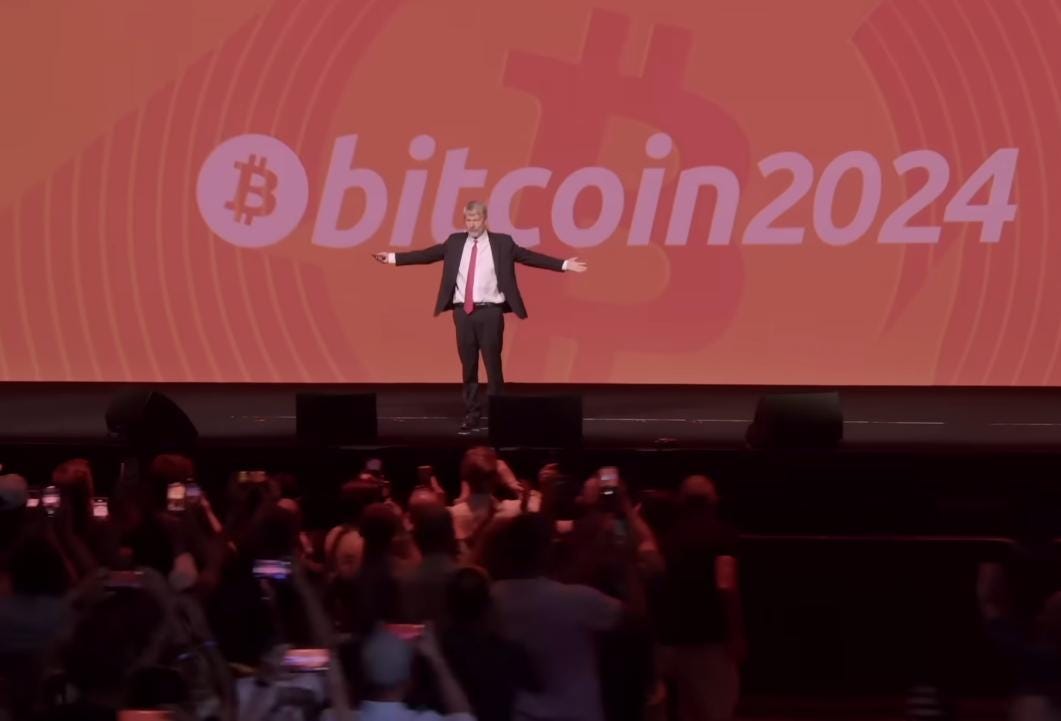
Little by little, Michael Saylor thus became a major opinion leader within the community. He was invited to speak at the major conferences dedicated to Bitcoin, both in the United States (Bitcoin Miami as early as 2021) and in Europe (notably BTC Prague in 2023). He drew audiences and was cheered by the crowd, as for example during the Bitcoin Atlantis event in Madeira. Moreover, Saylor quickly acquired the status of Bitcoin spokesperson beyond the narrow circle of maximalists, appearing on wide-audience podcasts such as Lex Fridman‘s in 2022, or Jordan Peterson‘s in 2025.
His company MicroStrategy has been a major buyer of bitcoins, contributing to the explosive rise in price. Over the course of six years, it accumulated 843,775 bitcoins at an average price of $75,653 (according to figures from July 21, 2026). To do so, it made extensive use of leverage by taking on debt, which inspired the phenomenon of Bitcoin Treasury Companies. But above all, it paved the way for financial institutions, and facilitated the approval of ETFs in 2024.
Today, Saylor’s influence is huge. His tweets, interviews, and speeches reach a massive audience, with views counted in the hundreds of thousands when not in the millions. Specialized media outlets talk about him constantly, seeing that the mere mention of his name catches people’s attention online. Saylor appeals in particular to young audiences, who see him as a model of success in the vein of a Warren Buffett or an Elon Musk. His words are repackaged into punchy short-form content, and have even been turned into meaningwave tracks known as “crypto meditations” available on YouTube.
The Danger of the Saylorian Dogma
Michael Saylor therefore possesses an obvious charm that fascinates crowds. His speeches are often very well crafted, music to the ears of his followers. However, this apparent harmony conceals a much darker reality.
Michael Saylor remains, above all, a financier. Anyone who listens carefully will notice that his rhetoric regularly contradicts Bitcoin’s core value proposition, namely owning your money without anyone being able to take it from you. Indeed, MicroStrategy’s CEO readily submits to all the sector’s regulations, and fully endorses financial surveillance practices such as know-your-customer. He makes a point of honor to reject the use of bitcoin as a direct medium of exchange, reserving that role for the dollar, which has legal tender status. He thus relegates Satoshi Nakamoto’s creation to the function of a financial asset. He sees nothing wrong with third-party custody, calling those who insist on self-custody “paranoid crypto anarchists,” even though the very raison d’être of cryptocurrency is disintermediation.
It may therefore seem strange that someone so hostile to Bitcoin’s fundamental values managed to become its figurehead. But this paradox is explained quite easily: it is straightforward corruption, that is, the surrender of a moral value in exchange for a monetary one. Many of us let the movement proceed by burying our heads in the sand, because the arrival of Saylor and Wall Street increased the purchasing power of our bitcoins. Indeed, not only were they acquiring them by the hundreds, but they also brought a certain legitimacy, increasing the number of people likely to get some. In a sense, we thought we were letting them buy our money, when in fact they were buying our silence.
Saylor’s rhetoric has thus proliferated among Bitcoin users, rendering the remonstrances of purists incredibly marginal. Today, for example, Andreas Antonopoulos’s adage “not your keys, not your coins” is no longer greeted with the same enthusiasm, as people are questioning the very principle of self-custody. This is why we will examine in detail, in a second article, the elements that make up the Saylorian dogma. For those who come after.
This post was translated from French using Kimi K3 on Venice.ai and then revised by myself. The illustration was produced with GPT Image 1.5.
Michael Saylor was “KPMG High Tech Entrepreneur of the Year” in 1996 and “Ernst & Young Software Entrepreneur of the Year” in 1997. He was recognized as one of the “Top 10 Entrepreneurs of 1998” by the Red Herring Magazine. He was part of the “Innovators Under 35” list of the MIT Technology Review in 1999.
Online gambling in the United States suffered enormously from the enforcement of the Unlawful Internet Gambling Enforcement Act, a law passed in 2006 that prohibited banks from processing transfers to platforms in the industry. In particular, online poker suffered the consequences on Friday, April 15, 2011, when the three main sites devoted to the game (PokerStars, Full Tilt Poker, and Absolute Poker) were shut down by the FBI.